What happened yesterday mid-afternoon? If you’ve looked outside and noticed hazy skies, you’re not imagining it. Smoke from Canadian wildfires can travel hundreds, even thousands, of miles, affecting air quality across Michigan and beyond. Again.
The good news after the last summertime Canadian wildfires, we researched and found tools to know when it’s time to change our plans, and a few simple precautions can make a big difference.
Michigan Health & Human Services air quality , University of Michigan / Michigan Medicine, and the EPA AirNow maps are excellent resources if you would like to learn more.

Image from previous Canadian wildfire (2025) of Lake Michigan at sunset near Leland, Michigan.
The easiest thing to check
Before heading outside, check the Air Quality Index (AQI) on AirNow.gov or your favorite weather app. AirNow is the EPA’s official source for air quality information. (here is specific information for Michigan)
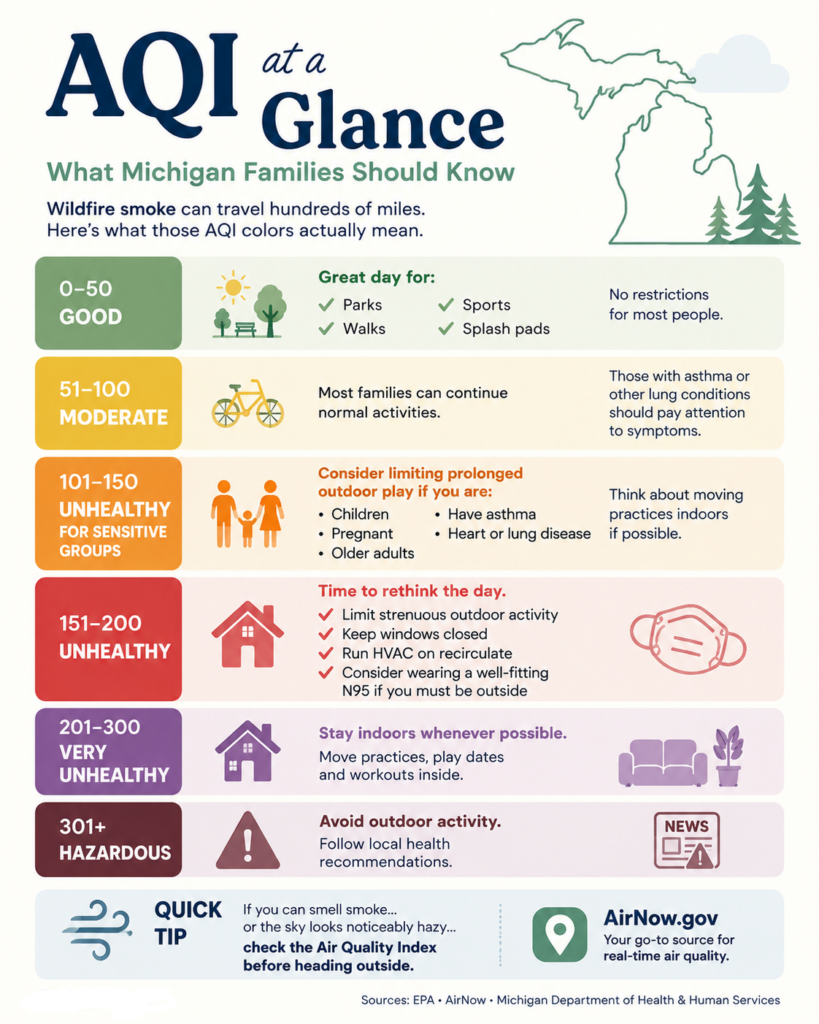
AQI Quick Guide
🟢 0-50 (Good)
Enjoy your day.
🟡 51-100 (Moderate)
Most people can be outside normally.
🟠 101-150 (Unhealthy for Sensitive Groups)
Children, older adults, pregnant people, and anyone with asthma or heart/lung conditions should reduce prolonged outdoor activity. Consider moving sports practices indoors if possible. (Michigan)
🔴 151-200 (Unhealthy)
Everyone should limit prolonged outdoor activity.
If you must be outside for any length of time, a well-fitting N95 or equivalent respirator is recommended. (Michigan)
🟣 201-300 (Very Unhealthy)
Stay indoors as much as possible.
Reschedule outdoor events if you can.
🟤 or a burgundy color 301+ (Hazardous)
Everyone should avoid being outdoors unless absolutely necessary. (ehs.umich.edu)
So…when should you pull out the N95?
Michigan health officials recommend a NIOSH-approved N95 or P100 respirator if you cannot avoid being outdoors during wildfire smoke events. Properly fitted KN95 and KF94 masks also provide good filtration if an N95 isn’t available. Cloth masks and surgical masks do not filter wildfire smoke effectively. (Michigan)
A simple rule of thumb:
- Orange: Consider one if you’re sensitive or will be outside awhile.
- Red: Strongly consider wearing one if you need to be outdoors.
- Purple/Hazardous: Stay inside whenever possible.
What about kids?
Children’s lungs are still developing, and they breathe more air relative to their body size than adults. That makes them more susceptible to smoke exposure. (Michigan Medicine)
If air quality is poor:
- Move playtime indoors.
- Skip strenuous outdoor activities.
- Keep windows closed if smoke is heavy.
- Run your HVAC on recirculate if possible or use a portable HEPA air purifier. (US EPA)
Whatever your family’s feelings were about masks in the past, wildfire smoke is different. An appropriately sized, well-fitting respirator can help reduce exposure to the tiny particles found in smoke when children need to be outside. Sometimes it’s simply another tool, like sunscreen on a sunny day or a bike helmet on a ride—to help protect growing lungs. (Michigan)
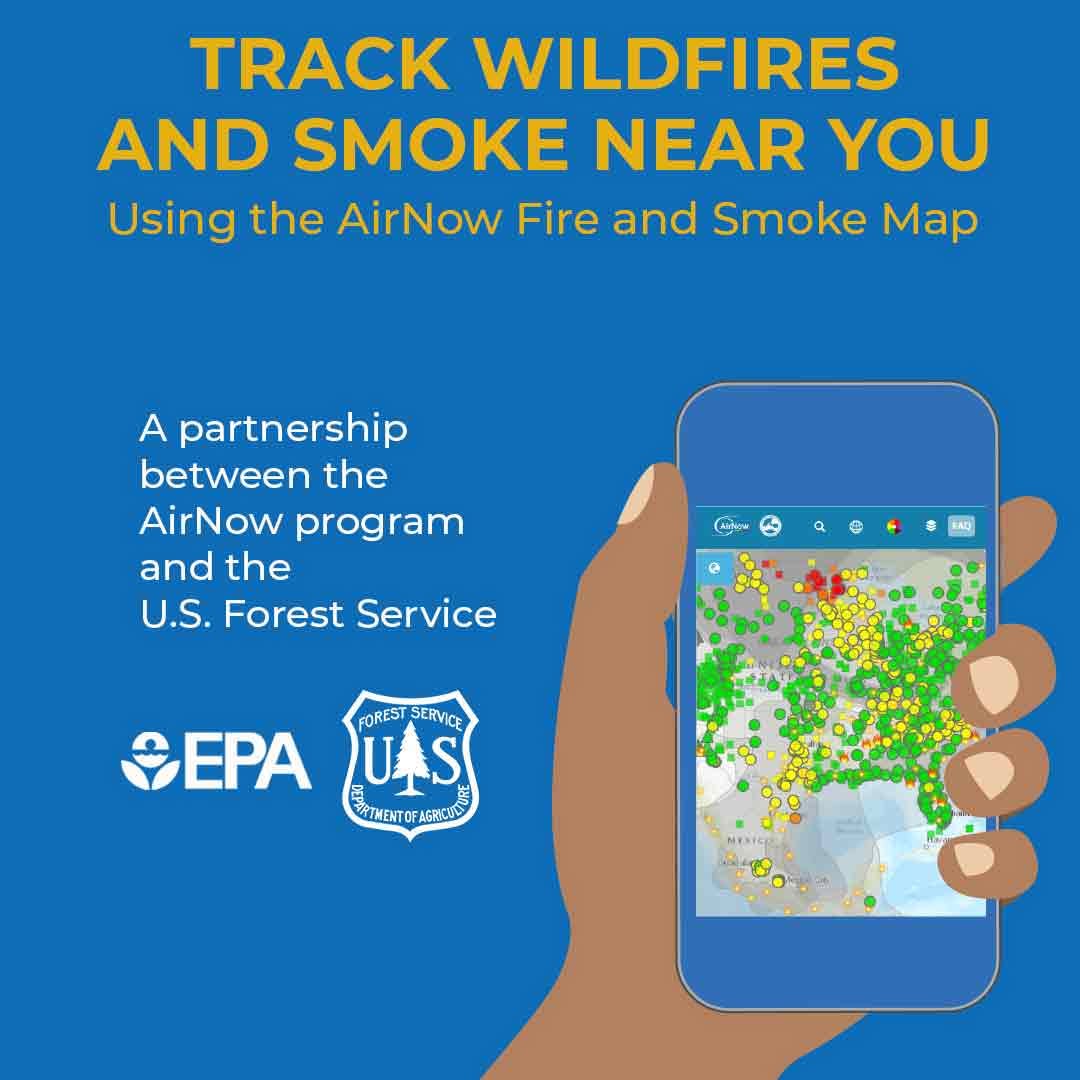
AirNow Map graphic from airnow.gov